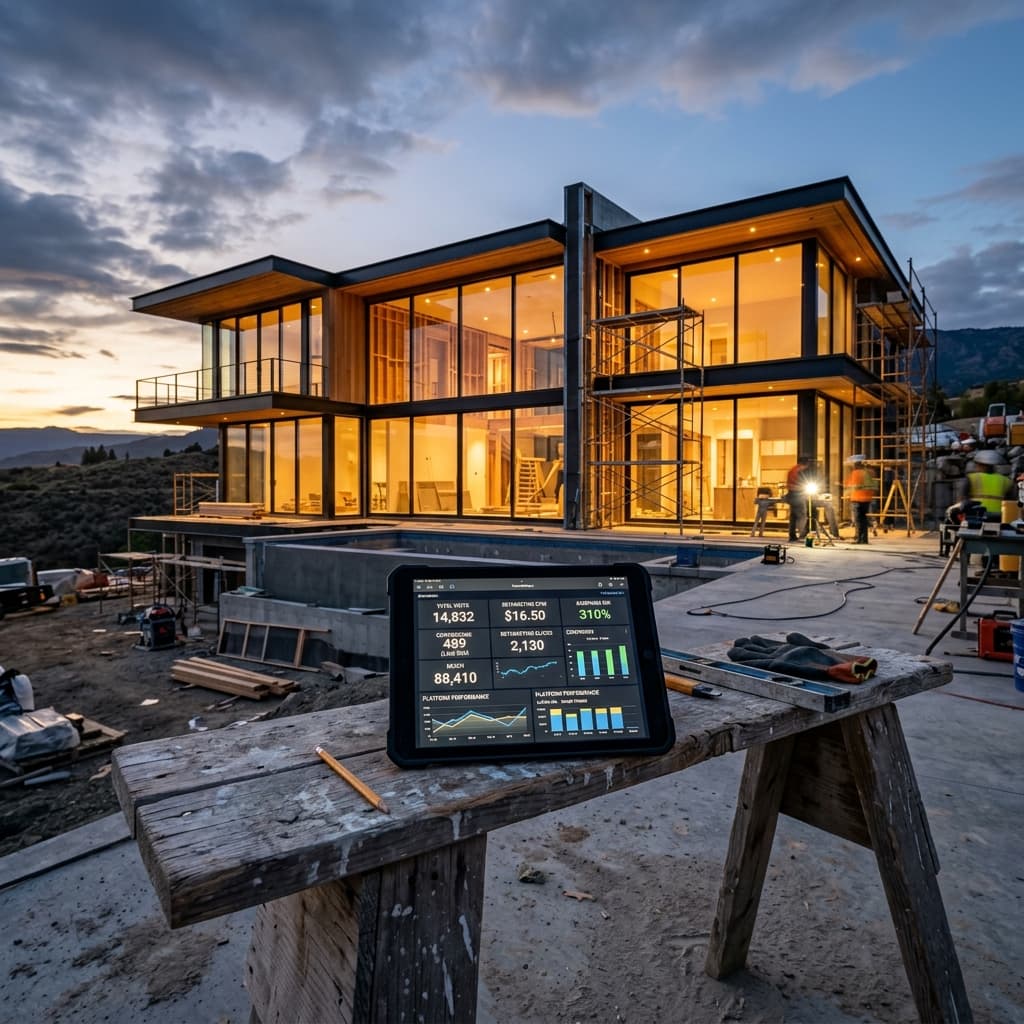
Word of mouth built your construction business, but it will not scale it. If you are a contractor relying solely on referrals or buying highly diluted, shared leads from directory agencies, you are actively choosing to compete on price rather than value. Here is the exact, data-driven blueprint for building an inbound B2B construction marketing engine that forces the market to see you as the premium, undisputed authority.

The Evolution of Construction Marketing: Beyond the Truck Wrap
The construction industry is experiencing a massive digital reckoning. For decades, the foundational bedrock of a construction company's marketing strategy was painfully simple: wrap the fleet trucks, put a sign in the yard of the current project, take an ad out in the local yellow pages, and pray that happy clients would refer their friends. This "strategy" was merely a byproduct of existence, not a systematic engine for growth.
Today, relying on that outdated model is a guaranteed path to margin compression. Why? Because the modern buyer—whether a homeowner looking for a kitchen remodel or a property manager seeking a commercial tenant finish—starts their journey on Google, validating their choices on social media, and scrutinizing reviews long before they ever pick up the phone. If your digital footprint is invisible, outdated, or looks exactly like the twenty other "affordable and reliable" contractors in your ZIP code, you have already lost the project to a competitor who understands how digital B2B construction marketing actually works.
What Does Not Work Anymore
Buying shared leads from platforms like Angi or HomeAdvisor forces you into a race to the bottom. When five contractors buy the exact same "roofing lead CA," the prospect optimizes for the cheapest price because the aggregator platform has commoditized the service. You are paying a premium to enter a bidding war where your brand equity equals exactly zero.
To break free from this vicious cycle, you must shift your mindset from "transactional lead buying" to "authoritative brand building." You need to build a machine that attracts high-intent prospects who specifically want to work with your company, allowing you to command premium prices and dictate the terms of engagement. This guide represents the comprehensive blueprint to achieving market dominance through systematic construction marketing.
Phase 1: The Digital Storefront (Your High-Conversion Website)

Your website is not a digital brochure; it is your 24/7, highest-performing sales representative. Yet, 80% of contractor websites we audit make the exact same fundamental errors: they lack a clear value proposition, they hide their contact information, their project galleries are disorganized, and they load incredibly slow on mobile devices. A poorly designed website actively repels high-budget clients who equate the quality of your digital presence with the quality of your physical craftsmanship.
To construct a digital storefront that converts fleeting visitors into high-ticket pipeline revenue, you must engineer the website around trust, clarity, and friction-less conversion. Here is the architectural breakdown of a high-converting construction marketing website:
- The "Above the Fold" Hook: You have fewer than three seconds to communicate what you do, who you serve, and where you operate. Your main headline (H1) should instantly disqualify bad leads and hook ideal clients. (e.g., "Premium Commercial Build-Outs in Orange County. Delivered On Time, Without Excuses.")
- Frictionless Conversion Architecture: A phone number in the top right corner is no longer enough. You need highly visible, contrasting Call-To-Action (CTA) buttons ("Request a Project Consultation") that remain sticky as the user scrolls, particularly on mobile devices.
- The Proof Portfolio: High-net-worth clients and commercial estimators do not buy promises; they buy proof. Your project gallery must feature high-resolution, professionally photographed case studies. Crucially, each project should include a brief narrative: What was the challenge? What was your solution? What was the timeline?
- Technical Speed & Web Vitals: Google explicitly punishes slow websites, particularly on mobile. If your hero image takes 4.5 seconds to load, your prospect hits the 'back' button and calls the competitor down the street. Optimize your images (use WebP), implement lazy loading for below-the-fold assets, and ensure your server response time is rapid.
The 60% Mobile Reality
Over 60% of local service queries occur on mobile devices. If your website requires pinching and zooming to read the text, or if the "Call Now" button is unclickable on an iPhone, you are actively burning your marketing budget. Mobile-first design is not optional; it is the entire foundation of modern contractor marketing.
Phase 2: Dominating the Local Map Pack (Local SEO)
When a commercial property manager searches for "commercial roofing CA" or "paving contractor near me," they are not looking for a blog post; they are looking for an immediate solution to a high-stakes problem. The first place they look is the Google Local Map Pack—the three business listings that appear directly below the map, above the standard organic search results. Ranking in these top three spots is the single highest ROI activity in construction marketing.
Ranking in the Map Pack is not magic; it is an algorithmic formula based on Proximity, Prominence, and Relevance. To manipulate this formula in your favor, you must ruthlessly execute on local SEO fundamentals that your competitors are too lazy to maintain.
Google Business Profile Supremacy
Claiming your GBP is step one. Step two is turning it into a conversion engine. You must ensure your NAP (Name, Address, Phone number) is 100% consistent across the entire internet. You must accurately select your primary and secondary business categories. Crucially, you must upload fresh, geotagged photos from real job sites every single week to signal to Google that your business is highly active.
The Review Velocity Engine
A 4.9-star rating with 150 reviews destroys a 5.0-star rating with 3 reviews. Google relies heavily on the volume, velocity, and sentiment of online reviews to determine prominence. You cannot leave reviews to chance. You must integrate an automated review request system (via text message or email) that triggers the exact moment a project is successfully completed and the client signs off.
Hyper-Local City Pages
If you serve a 50-mile radius that encompasses 12 different cities, you cannot rank for all of them using just your homepage. You must build dedicated service-area pages (e.g., /roofing-contractor-irvine, /roofing-contractor-newport-beach). These pages must feature localized content, reviews from clients in that specific ZIP code, and embedded Google Maps showing past projects in that exact jurisdiction.
Phase 3: Systematic Pipeline Generation (Organic SEO & Paid Media)

While Local SEO captures the immediate, high-intent "near me" searches, long-term market dominance requires a dual-pronged approach: establishing organic topical authority (SEO) and deploying precision-targeted paid media (PPC) to control your lead pipeline like a faucet.
The Architecture of Construction SEO: Creating random blog posts about "Why you need a new roof" will generate exactly zero qualified leads. True construction SEO requires identifying the exact pain-point queries your ideal clients are searching for, and answering them better than anyone else on the internet. This is known as bottom-of-funnel content marketing. For a GC, this means creating deeply educational content around topics like "Cost to build a commercial kitchen in Los Angeles" or "Navigating CA Title 24 compliance for office remodels." By answering complex, high-friction questions, you intercept prospects during their research phase, establishing your firm as the de facto authority long before they ask for a bid.
Precision Paid Media (Stop Wasting Google Ads Budget): Most contractors who attempt Google Ads or Facebook advertising lose their shirts because they bid on broad terms ("contractor") instead of high-intent, exact-match keywords ("commercial HVAC replacement contractors"). Furthermore, they drive expensive ad traffic directly to their generic homepage instead of highly optimized, service-specific landing pages.
The Bleeding Strategy
Bidding $40 a click on broad terms, pointing traffic to a slow homepage with no clear phone number, and hoping the user figures out how to navigate to the contact form. Result: 2% conversion rate, astronomical Customer Acquisition Cost (CAC).
The Sniper Strategy
Bidding on exact-match commercial intent queries. Routing traffic to a lightning-fast, dedicated landing page that removes the navigation bar, displays 3 high-end case studies, and features a sticky lead capture form. Result: 15%+ conversion rate, highly profitable CAC.
Phase 4: Establishing Market Authority (Brand & Retargeting)
Construction is a high-trust, high-ticket industry. A commercial developer will not award a $2.5 million contract based solely on a Google Ad click. They require repeated psychological reinforcement to believe that your brand is the safest, most competent choice. This is where advanced brand marketing and pixel-based retargeting become your most potent weapons.
When a prospect visits your website but does not fill out a contact form (which happens 85% of the time, even on optimized sites), you do not let them disappear into the ether. By placing tracking pixels (Meta Pixel, Google Insight Tag) on your digital storefront, you can deploy "omnipresence retargeting."
For the next 30 days, wherever that specific prospect navigates on the internet—whether they are reading the news, scrolling through Facebook, or watching a YouTube video—they will see highly professional, high-impact advertisements showcasing your recent completed projects, your team on the job site, and video testimonials from ecstatic clients. You manufacture the perception that your company is the biggest, most reputable player in the market, drastically shortening the sales cycle when they are finally ready to pull the trigger.
Phase 5: The Analytics Layer (Tracking What the Money Does)

The difference between spending money on advertising and investing capital into a marketing engine lies entirely in data attribution. You cannot scale a construction business to 8-figures if you cannot definitively answer this question: "If I put $1.00 into this marketing channel today, exactly how many dollars come back in signed contracts, and how long does it take?"
Implementing a rigorous analytics layer means moving past vanity metrics like "impressions" or "website clicks." You must implement dynamic call tracking using tools like CallRail to trace every distinct inbound phone call back to the exact Google Ad or SEO page that generated it. You must integrate your website forms with a robust CRM (like HubSpot or GoHighLevel) to tag leads by their source, track their progression through the sales pipeline, and ultimately calculate your precise Customer Acquisition Cost (CAC) by channel.
When you know that your SEO efforts generate commercial leads at $85 per acquisition with a 20% closing rate, while your Google Ads generate leads at $250 with a 15% close rate, you no longer guess about your marketing budget. You treat marketing as a mathematical mechanism to print profitable revenue, scaling the winning channels and ruthlessly cutting the losers.
The Role of CRM & Lead Nurturing
Generating the lead is only step one. The silent killer of construction marketing ROI is poor pipeline management. When a homeowner submits a request for a $150,000 custom build, expecting them to convert on the first phone call is statistically naive. You must deploy an automated email and SMS nurturing sequence via your CRM.
This sequence should not consist of aggressive sales pitches. Instead, it should deliver profound value. Send them a comprehensive PDF guide on "How to Avoid the 5 Most Expensive Mistakes During a Custom Home Build." Send them video walkthroughs of your job sites explaining your rigorous quality control processes. You are essentially pre-selling the prospect on your expertise during the weeks (or months) they spend finalizing their financing and architect plans. When they are finally ready to sign a contract, they won't even solicit bids from your competitors because they already perceive you as the singular trusted advisor.
Understanding Customer Lifetime Value (LTV) vs. Customer Acquisition Cost (CAC)
Amateur contractors panic when a Google Ad lead costs $300. Professional construction CEOs understand that a $300 lead is a massive bargain if the resulting project yields $40,000 in gross profit, and that client subsequently refers three more identical projects over the next five years. This is the LTV:CAC ratio.
To dominate your market, you must be willing to spend more to acquire a customer than your competitors. If your competitor's maximum allowable CAC is $500, and your streamlined operations allow you a maximum CAC of $1,500, you will inevitably outbid them on every premium keyword, occupy all the prime digital real estate, and starve them of inbound volume. You buy market share by mathematically understanding what a client is truly worth to your enterprise over a entire decade, not just on the initial transaction.
The 2,500+ Word Commitment
To truly dominate a market, your educational material must be overwhelmingly comprehensive. Shallow, 500-word blog posts written by cheap freelancers do not build authority with multi-million dollar developers or high-net-worth homeowners. This level of extreme architectural detail—covering everything from the psychology of the buyer down to the specific analytics pixels—is what forces the market to respect your brand as the definitive thought leader.
Final Blueprint Checklist: Engineering Your Enterprise Exit
Before you spend another dollar on scattered advertising or shared leads, audit your current marketing infrastructure against this foundational blueprint:
- Is your website loading in under 2.5 seconds with clear, friction-less conversion points?
- Do you have an automated post-project review acquisition system actively generating 5-star Google reviews?
- Are you bidding on exact-match commercial keywords and driving that traffic to isolated, highly-relevant landing pages?
- Are you utilizing the Meta and Google pixels to maintain 30-day omnipresence in front of unconverted website visitors?
- Is every single phone call and form submission meticulously tracked and attributed back to its original marketing source in your CRM?
The Cost of Inaction: Building the Engine vs. Renting the Audience. Buying shared leads from directory agencies is renting someone else's audience. You are entirely at the mercy of their inevitable price hikes, their algorithmic changes, and their ruthless business decision to sell the absolute exact same lead to five of your direct competitors simultaneously. You are building their enterprise value, not yours.
Building your own digital storefront, dominating your local SEO map pack, engineering highly precise paid media funnels, and tracking the data ruthlessly is building your own independent engine. It requires upfront time, deliberate capital allocation, and extreme technical execution—but it is the only viable path to exiting the commodity rat race. When you own the engine that produces predictable, high-margin revenue, you are no longer just running a contracting business; you are building a highly scalable, acquirable enterprise with unassailable profit margins. The blueprint is laid out above; the only variable left is whether you have the discipline and foresight to execute it before your competitors do.

Stop Buying Leads. Start Building Your Engine.
If you are tired of competing on price and want to build a predictable, self-owned inbound lead generation engine for your construction business, let's architect the strategy.
Request a Strategy SessionYou may also find valuable

Marketing Plan for Construction Company: The Mathematical Eradication of "Referrals"
April 16, 2026
Fractional CMO for Construction: Executive Growth Without the $250k Salary
April 8, 2026
Inbound Marketing for Commercial Contractors: Why Outbound Cold Calls Are Dead and Your Website Should Be Your #1 Sales Rep
April 15, 2026