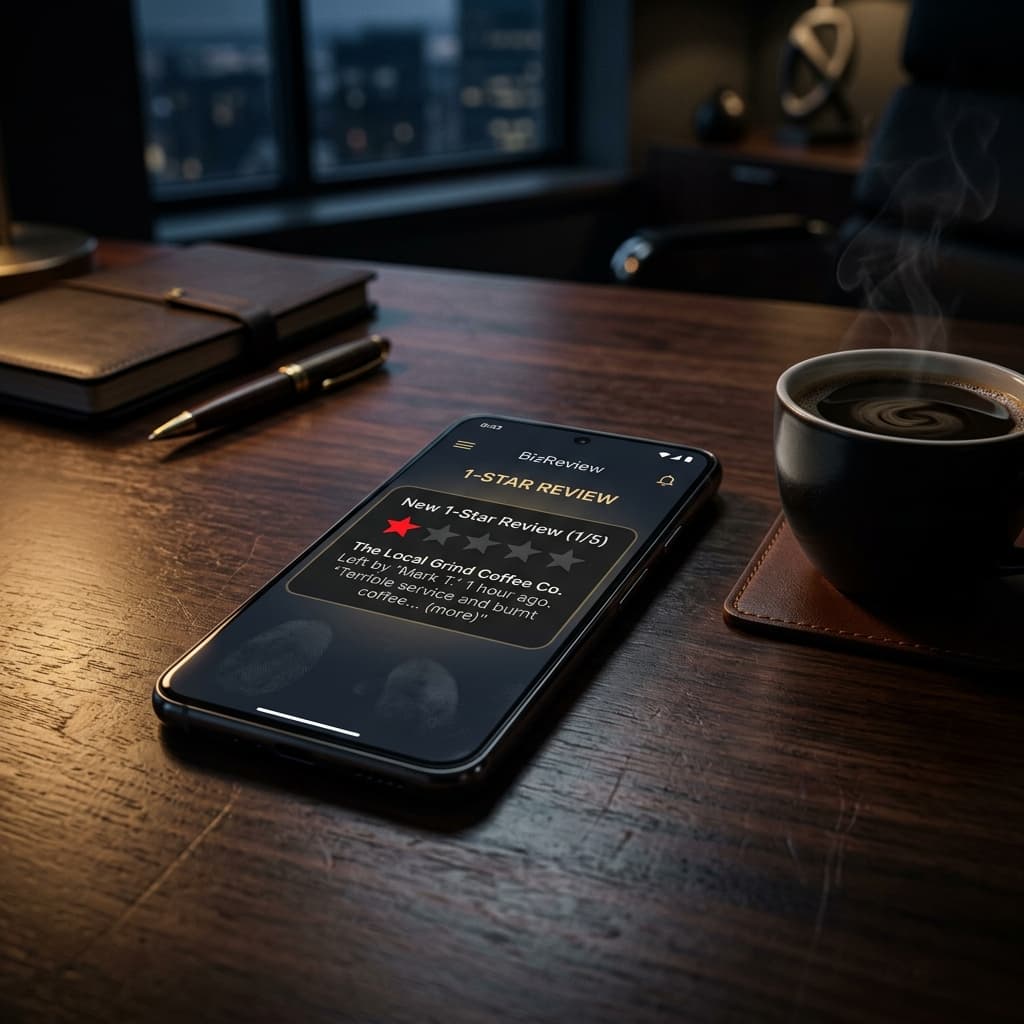
A negative review on your Google Business Profile is not a public relations inconvenience. It is an active algorithmic event that restructures how every future high-intent search query evaluates your firm's credibility. For a commercial contractor competing for eight-figure infrastructure bids, a single unanswered one-star review functions as a permanent, publicly visible disqualification notice—one that institutional developers, municipal procurement directors, and enterprise real estate funds will read before they ever open your capability statement.

The Psychological Impact on Institutional Buyers
Institutional developers do not evaluate contractors the way residential homeowners do. A homeowner reads reviews to gauge friendliness and punctuality. An institutional developer—a director of capital projects at a healthcare system, a VP of facilities at a logistics conglomerate, a municipal public works commissioner—reads reviews to assess operational risk. They are not looking for five-star praise. They are looking for evidence of systemic failure. A single negative review alleging poor workmanship, project delays, or safety violations does not merely reduce your star rating. It plants a seed of institutional doubt that no capability statement, no matter how polished, can fully overcome.
The psychology is brutally asymmetric. Research consistently demonstrates that negative information carries approximately five times the cognitive weight of positive information in risk-assessment scenarios. When a procurement director sees your firm's 4.7-star rating and 85 glowing reviews, they process that as expected baseline competence. When they scroll down and find a single detailed, unreplied one-star review from a former subcontractor alleging that your firm failed to pay invoices on time and created unsafe working conditions, that single review overwrites the cognitive authority of every positive review above it. It becomes the dominant narrative.
The critical variable is not whether the negative review exists—every firm of meaningful operational scale will accumulate negative reviews over time. The critical variable is whether you have responded to it, and how. An unanswered negative review communicates one of two things to an institutional buyer: either you are unaware of your own digital presence (operationally negligent), or you are aware of the criticism and have chosen to ignore it (arrogantly dismissive). Neither interpretation survives a due diligence evaluation.
The 48-Hour Window
Google's algorithm monitors review response velocity as a ranking signal. A negative review that goes unanswered for more than 48 hours begins to actively suppress your local ranking authority. The algorithm interprets non-response as disengagement—a signal that your business may not be actively managed. Meanwhile, every qualified lead searching for "commercial builder [your city]" during that window sees an uncontested accusation as the most prominent piece of social proof on your profile.
The Strategic Response Framework
Elite commercial contractors do not respond to negative reviews emotionally. They deploy a structured, legally vetted, algorithmically optimized response framework that transforms every negative review into a demonstration of institutional competence. The framework operates on four non-negotiable principles: acknowledgment without admission, empathy without capitulation, resolution pathway without liability, and keyword integration without artificial stuffing.
The first principle—acknowledgment without admission—requires the responder to explicitly recognize the reviewer's experience as valid without conceding legal fault. "We take every piece of feedback from our project partners seriously" acknowledges the concern. It does not say, "We made a mistake." This distinction is not merely a legal technicality; it is a critical defense against potential litigation where a public admission of fault in a review response could be introduced as evidence.
The second principle—empathy without capitulation—demonstrates emotional intelligence without surrendering the firm's professional authority. "We understand that construction projects involve complex coordination across multiple stakeholders, and we regret any frustration that may have resulted from communication gaps" expresses genuine concern without accepting blame for the alleged issue. It positions your firm as emotionally mature and operationally self-aware, qualities that institutional buyers value above almost everything else.
The third principle—resolution pathway—immediately transitions the conversation from the public forum to a private channel. "We invite you to contact our project management office directly at [phone] so we can review the specifics of your concern and work toward a resolution" achieves two objectives simultaneously: it demonstrates to every future reader that your firm proactively resolves disputes, and it removes the detailed exchange from public view where further allegations could compound the reputational damage.
The fourth principle—keyword integration—leverages the response itself as an SEO asset. Google's Natural Language Processing engine reads review responses and indexes them as content associated with your business entity. A response that naturally incorporates phrases like "commercial construction," "project management," and your geographic market ("Los Angeles," "Orange County") effectively turns a negative review into an organic search optimization opportunity. The response becomes indexed content that reinforces your relevance for high-value commercial construction queries.
The 4-Principle Response Protocol
- Acknowledge Without Admitting: Validate the experience without conceding legal fault. Protect your firm from litigation exposure.
- Empathize Without Capitulating: Demonstrate emotional intelligence and operational maturity without accepting blame.
- Offer Resolution Privately: Move the conversation offline to prevent public escalation while demonstrating dispute resolution commitment.
- Integrate Keywords Naturally: Embed geographic and service keywords in your response to convert the review thread into indexed SEO content.

The Algorithmic Velocity Dilution Strategy
Responding to a negative review is a defensive measure. The offensive counterpart is a systematic review velocity campaign designed to rapidly dilute the algorithmic and visual impact of the negative review through a sustained influx of high-quality, keyword-rich positive reviews from verified commercial clients. This is not about buying fake reviews or soliciting mass generic praise. It is about engineering a deliberate, ongoing flow of authentic, detailed testimonials from institutional clients that overwhelm the negative signal with an avalanche of positive data.
The mathematics are straightforward. If your firm has 40 reviews with a 4.6-star average and receives a single one-star review, your visible rating drops to approximately 4.51. If, in the following 30 days, you secure 10 new five-star reviews from commercial clients, your rating recovers to approximately 4.65—actually higher than before the negative review appeared. More importantly, the negative review is now buried beneath 10 recent, detailed, keyword-rich positive reviews. The visual prominence of the criticism has been systematically neutralized by volume.
The key to sustainable review velocity is integration into your existing project closeout workflow. When a commercial project reaches substantial completion and the client has expressed satisfaction, your project manager should immediately trigger a structured review request sequence. This sequence includes a personal email from the project executive, a direct link to the Google review page, and specific guidance encouraging the client to mention the type of project (healthcare facility, logistics warehouse, municipal infrastructure), the geographic location, and the specific value your firm delivered. This guidance is not manipulative; it is informational. It helps the reviewer articulate the details that the Google NLP engine uses to strengthen your semantic authority in the specific commercial construction categories where you compete for high-value bids.
Flagging and Removing Illegitimate Reviews
Not every negative review is legitimate, and elite contractors maintain an aggressive posture toward reviews that violate Google's content policies. Reviews that contain defamatory language, that are posted by individuals with no verifiable business relationship to your firm, that are clearly posted by competitors or disgruntled former employees with personal grudges, or that reference events or interactions that never occurred—all of these categories are eligible for removal through Google's review flagging system.
The flagging process requires documented evidence and persistence. A single flag submission rarely results in removal. Professional reputation management agencies submit flagging requests through Google's Business Profile support channels, accompanied by documented evidence of policy violations, sworn declarations from company officers attesting that the reviewer has no business relationship with the firm, and detailed explanations of the specific Google content policies that have been violated. In cases involving clearly defamatory or fraudulent reviews, some firms escalate to legal counsel who issue cease-and-desist letters or file formal defamation complaints that provide Google with the legal basis for expedited removal.
The Competitive Authority Advantage
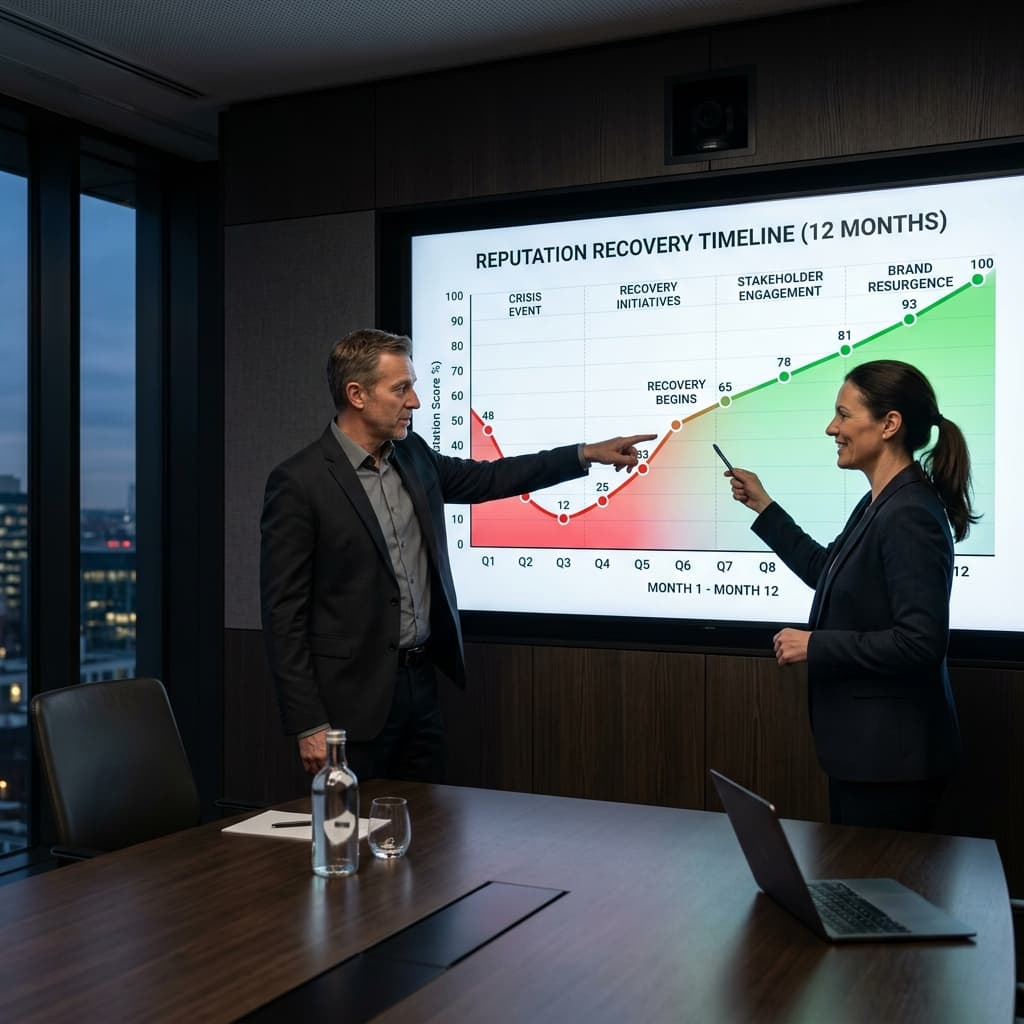
The contractors who dominate competitive commercial markets in California have not achieved review superiority by accident. They maintain dedicated internal processes that treat review management with the same operational rigor as safety compliance or financial reporting. They respond to every review—positive and negative—within 24 hours. They execute quarterly review velocity campaigns timed to coincide with project completions. They monitor their review profiles across every platform—Google, Yelp, Facebook, The Blue Book, Procore—on a weekly cadence. They maintain a documented escalation protocol for reviews that require legal intervention.
The result is a review profile that communicates institutional maturity to every future evaluator. When a municipal procurement director reviews your firm against three competitors and sees that you have 150 reviews with a 4.8-star rating, that every negative review has received a professional response within 24 hours, and that the most recent 20 reviews all reference specific commercial project types and California geographies—they are not just seeing social proof. They are seeing operational excellence. They are seeing a firm that manages its digital assets with the same precision it applies to managing a $40M construction project. That perception directly translates into shortlist inclusion and ultimately into signed contracts.
Negative reviews are inevitable. They are the cost of operating at scale in a complex, high-stakes industry. The firms that treat them as threats to be ignored or endured are surrendering algorithmic authority with every passing day. The firms that treat them as strategic opportunities—systematically responding, strategically diluting, aggressively flagging illegitimate content, and continuously building review velocity—are the firms that force the algorithm to rank them at the top of every high-value local search in their market. That is the Lemonade Standard.

Command Your Reputation. Dominate the Search.
Lemonade Ideas deploys institutional-grade reputation engineering for elite commercial contractors. We respond strategically, dilute algorithmically, and build review velocity systems that transform your digital reputation into an unbreakable competitive moat.
Deploy Reputation ShieldYou may also find valuable

The Million-Dollar Leak: Eradicating Fake Google Reviews Destroying Your Commercial Pipeline
April 8, 2026
Contractor Reputation Repair: The Institutional-Grade Playbook for Rebuilding Digital Authority
April 10, 2026
Algorithmic Monopoly: Weaponizing Your Google Business Profile
April 10, 2026