In the fiercely competitive, high-stakes landscape of commercial construction and specialized home services across California, operational obscurity is your absolute greatest financial liability. Plumbers, commercial roofers, Tier-1 HVAC technicians, and high-end general contractors routinely spend hundreds of thousands—often millions—annually on cutthroat digital advertising platforms like Google Local Services, Facebook Meta Ads, and Yelp. Yet, shockingly, these exact same firms systematically neglect their most visible, highest-converting physical marketing asset: the commercial work truck. A premium, mathematically designed fleet wrap generates between 30,000 to 70,000 daily vehicular impressions in a major metropolitan area. When executed correctly, a $3,500 highly-durable vinyl investment transforms a rapidly depreciating physical asset into a hyper-localized, 24/7 mobile billboard that yields the lowest Cost Per Impression (CPM) verifiable in modern marketing history. Definitively, if your heavy-duty service vehicles are driving around local municipal grids effectively naked or with cheap magnetic decals, you are quite literally subsidizing the pipeline growth of your fiercest competitors.
The Fallacy and Danger of the Magnetic Door Sign
It is endlessly astonishing that in an era where heavy civil contractors are deploying advanced LIDAR drones for topographical site mapping and utilizing complex AI language models to rapidly estimate massive commercial steel bids, the marketing standard for their physical neighborhood presence remains tragically stagnated in the mid-1990s. The prevalent, outdated industry mindset treats service vehicle branding as a tedious, annoying obligational afterthought—a menial task delegated to the lowest possible bidder at a local strip-mall print shop who slaps a generic, unreadable 12x24-inch magnetic sign on the dented door of a Ford F-250 and calls it a finished marketing campaign.
This represents a severe, negligent misallocation of brand potential. A tiny magnetic sign barely clinging to the side of a dirty, unwashed white cargo van does not command respect from high-net-worth clients; it explicitly signals amateurism and a lack of permanence. When your crew pulls up to execute an $8-million custom residential build in Beverly Hills, or attempts to secure a massive commercial healthcare facility maintenance contract in downtown San Diego, the decision-makers on site—the master architects, the aggressive land developers, the cynical property managers—judge the sophistication, reliability, and financial stability of your entire operation within the exact first three seconds of observing your vehicle.
Human psychology relies heavily on heuristics. If your work truck looks like a transient "guy in a truck" operation, you will inevitably be negotiated with like a transient "guy in a truck." They will haggle over minor line items and demand constant supervision. Conversely, if your entire fleet rolls onto the job site looking like a multi-million-dollar, highly organized, militant corporation with uniform, stunning graphics, you immediately command authority. You instantly justify your premium pricing matrix before your technicians ever even speak a word to the client.
What Doesn't Work: The Overcrowded "Billboard" Design
The absolute most destructive mistake enthusiastic contractors make when purchasing a full vehicle wrap is attempting to turn the side of the van into a comprehensive 10-page informational brochure. They aggressively instruct the wrap designer to include a massive, microscopic bulleted list detailing every single sub-service they offer, five different phone numbers for various departments, a massive QR code taking up a third of the panel, and a chaotic, headache-inducing background image of fake lightning bolts, tearing metal, or tribal flames. A vehicle moving at 65 miles per hour on the massive 405 freeway gives a passing viewer exactly 2.5 seconds to comprehend the primary message. Bullet points are lethal to vehicle marketing ROI. If they cannot read your brand name and your core service instantly, your wrap has fundamentally failed its singular purpose.
The industry paradigm must drastically shift away from the simplistic goal of "let's just make sure we put our company logo on the truck to be legally compliant," toward the sophisticated strategy of "let's aggressively engineer a highly visible, mobile conversion funnel." When meticulously executed with the strict mathematical principles of Conversion Rate Optimization (CRO), a fleet wrap ceases to be a decorative expense. It instead serves as the immensely wide top of an extremely lucrative inbound sales funnel that feeds highly qualified, pre-warmed traffic directly into your conversion-optimized website and automated booking engine.
The Indisputable Mathematics of Cost Per Mille (CPM)
To fully appreciate the financial absurdity of ignoring or cheapening your fleet wraps, we must ruthlessly examine the objective mathematics of Cost Per Mille (CPM)—the standard advertising metric denoting the fixed cost required to achieve exactly 1,000 marketing impressions from human eyes. In today's saturated digital landscape, acquiring qualified human attention is astronomically hyper-expensive, heavily manipulated by algorithms, and highly volatile year-over-year.
Consider the deeply painful baseline metrics for common contractor marketing channels currently operating in high-density, highly competitive markets like Southern California, Texas, or Florida:
- Google Ads (Pay-Per-Click): An aggressive commercial contractor might pay between $25 to an astounding $150 for a single, solitary click on high-intent search keywords like "emergency commercial roofer near me" or "industrial HVAC repair Los Angeles." Because not every impression results in a click, the CPM just for mere search network visibility can easily surge past $100 depending entirely on the viciousness of the local auction density.
- Direct Mail Campaigns: Sending 5,000 premium, glossy, oversized postcards to highly affluent neighborhoods will cost your firm approximately $3,000 in raw printing and bulk postage. This equates to a staggering CPM of $600—and statistically, over 95% of those expensive mailers are unceremoniously discarded into the recycling bin within four seconds of the homeowner reaching the mailbox.
- Traditional Highway Billboards: Depending entirely on prime highway traffic visibility, renting a stationary physical billboard runs a company anywhere from $2,000 to $10,000 per month. While yielding a respectable CPM of roughly $3 to $8, the fundamental flaw is that its audience is geographically static; if your ideal customer doesn't drive down that specific stretch of the I-5 freeway, they never once see your brand.
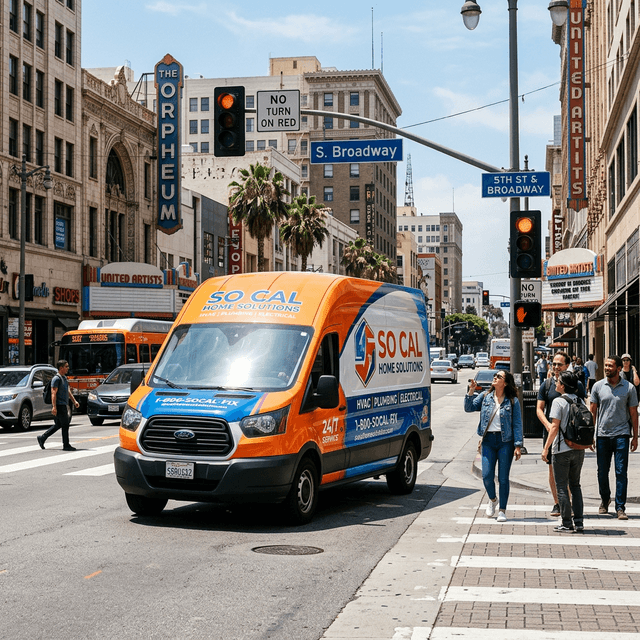
Now, calculate the ruthless mathematics of a premium Fleet Wrap. According to extensive traffic studies conducted by the Outdoor Advertising Association of America (OAAA), a single wrapped commercial vehicle operating normally in a major metropolitan area generates anywhere between 30,000 and 70,000 daily visual impressions. This is not static; it penetrates wealthy gated communities where billboards are illegal, and it parks directly in front of commercial plazas where your target B2B clients operate.
The 5-Year Asset Amortization Advantage
A high-end, professionally installed wrap utilizing top-tier 3M cast vinyl costs approximately $3,500. A standard commercial vehicle is kept in service and on the road for an average lifecycle of 5 years. This equates to an amortized marketing investment of roughly $1.91 per day. If that heavily branded van generates a conservative 40,000 impressions a day across the city grid, the resulting CPM is an astonishing $0.04. You are literally purchasing 1,000 local eyeballs for four pennies. There is absolutely no other advertising channel on the planet—whether digital, print, or broadcast—that can even remotely compete with this level of mathematical efficiency.
The Architecture of a High-Converting Wrap
Understanding the underlying CPM logic is only the absolute first step. Generating 70,000 daily impressions is completely useless if those impressions do not actively convert into high-ticket pipeline revenue. The structural, graphic design of the wrap explicitly dictates the ultimate conversion rate. The objective of the design is emphatically not to look "pretty" or "cool"; the objective is to forcefully trigger immediate brand recognition, convey extreme, undeniable professionalism, and command a definitive action from the viewer before the light turns green.

The 3-Second Rule (The Hierarchy of Cognitive Scale)
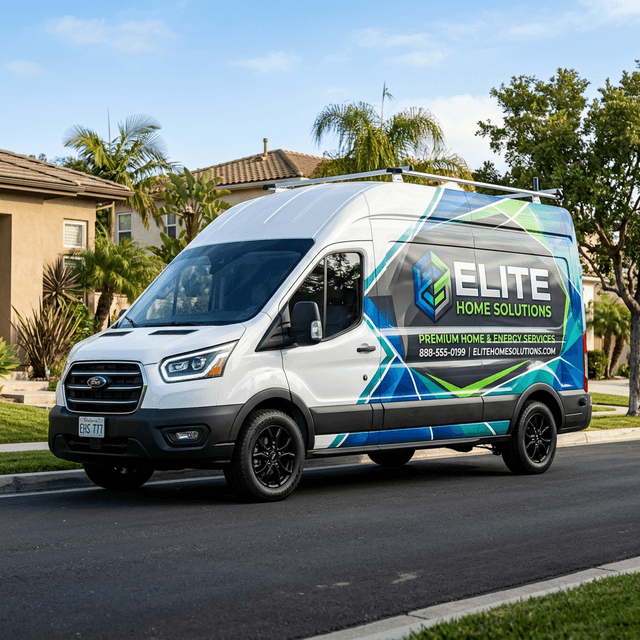
Every single visual element plastered on the vehicle must pass the brutal 3-second highway readability test. The hierarchy of scale must be militaristically strict. First: Your Logo/Brand Name (Massive, unmistakable, spanning the largest flat panel). Second: What You Do (e.g., "Commercial Roofing" or "24/7 HVAC" in a highly legible font). Third: How they reach you (Website/Phone). Everything else—the bullet lists, the BBB logos, the list of counties you serve—is active visual pollution that slows down cognitive processing. Eliminate the clutter ruthlessly.
Mastery of Contrast and Rapid Legibility
Intricate, heavily layered background designs, gradients, or complex photographic textures absolutely destroy text legibility from a distance. For maximum impact, utilizing a high-contrast binary color palette is mandatory. Consider dark charcoal or matte black backgrounds violently contrasted with neon green, bright safety yellow, or optic orange lettering. Conversely, pristine, clinical white backgrounds paired with aggressive black/red accents work brilliantly. The font choice must be a heavy, structurally sound sans-serif (e.g., Montserrat, Oswald, or uppercase Arial Black). Never, ever use delicate script, cursive, or thin serif fonts on a moving vehicle; they become invisible at 30 miles per hour.
The Call-to-Action (CTA) Geographic Priority
Many older contractors mistakenly make their local phone number the absolute largest element on the truck. In the smartphone era, this is often a critical mistake. People do not memorize arbitrary 10-digit numbers while moving at 60 mph. They do, however, easily memorize a catchy, punchy website domain. The website URL should generally be the most prominent piece of contact information strategically placed on the rear doors or tailgate of the vehicle, as this is the face stared at longest by millions of bored drivers sitting in heavy commuter traffic directly behind your van.
Brand Omnipresence and "The Illusion of Massive Scale"
There is a deeply embedded, highly predictable psychological phenomenon in consumer behavior specifically regarding urban fleet marketing. When a homeowner or a commercial property manager sees a masterfully designed, brightly colored van parked at a massive job site down the street on a Tuesday morning, and then coincidentally sees the exact same vibrant design driving past their office window on Thursday afternoon, their brain registers the brand twice in rapid succession.
If the design is incredibly striking and memorable, their subconscious instantly assumes the company is a massive, dominant regional force. An upstart plumbing company might, in reality, only own three vans. But if all three vans are wrapped in an identical, high-end, aggressive, high-contrast design, and they are circulating heavily through a singular, densely populated 15-mile radius city zone, the community will genuinely perceive that the company operates a fleet of thirty or forty vehicles. This is heavily documented in the home service franchise sector—where rapid deployment of identical, bold wraps creates an immediate, synthetic perception of absolute market dominance and reliability. You look like the "big, trustworthy corporation" in town, instantly, before you ever actually reach that size.
Integration with The Digital Ecosystem
A fleet wrap cannot, and does not, operate in a vacuum. It is merely the physical, mobile manifestation of your digital footprint. This exact transition point is where 90% of local contractors fail spectacularly. Generating a lead on the highway means absolutely nothing if the digital infrastructure isn't built to capture and metabolize it.
Imagine the following scenario: A stressed facility manager for an $80M commercial hospital is sitting in gridlocked traffic. A stunningly wrapped, hyper-professional commercial HVAC truck pulls in front of him. The branding is clean, authoritative, and loudly promises "24/7 Commercial Rapid Dispatch." The manager remembers the bold brand name "Apex Thermal Engineering" and Googles it frantically when he finally reaches his office.
If the facility manager searches "Apex Thermal Engineering" and lands on a broken, non-mobile-responsive website built on a cheap template in 2013 that takes 8 excruciating seconds to load, the immense trust generated by the premium truck wrap is instantly evaporated. The cognitive dissonance between the high-end physical asset he saw on the road and the low-end, neglectful digital asset he sees on his monitor creates severe suspicion. He clicks away, calls a competitor with a faster site, and you lose a $1.2M annual maintenance contract without ever knowing it existed.
To capture the staggering true ROI of a fleet wrap, your entire digital ecosystem must be optimized to receive the traffic flawlessly. Your website must be lightning-fast (passing Google Core Web Vitals with flying colors), your brand identity must perfectly match the specific hex-colors and typography of the physical wrap, and your Google Business Profile must be heavily fortified with dozens of recent 5-star reviews to socially validate the aggressive authority projected by the truck. The truck merely initiates the curiosity; the website must close the deal.
Protecting the Financial Investment: Materials and Installation Rigor
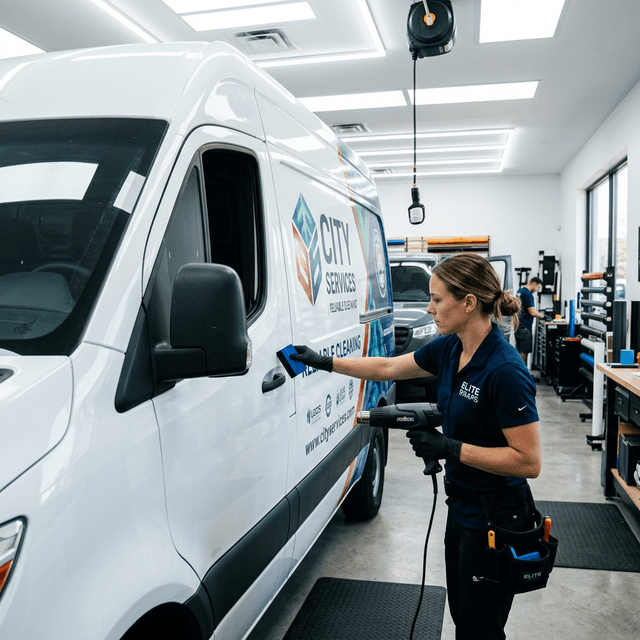
When dealing with fleet wraps as a serious capital expenditure, the absolute worst operational decision a firm can make is selecting the installation vendor based solely on the lowest estimated price. The commercial wrap industry is absolutely flooded with low-tier "sign shops" utilizing cheap, non-conformable calendared vinyl and inexperienced installers who routinely slice deeply into expensive vehicle paint with their cutting knives, rusting out vans within months.
A premium, ROI-positive wrap requires a premium architectural foundation. You must explicitly specify, in the contract, the use of top-tier cast vinyl—specifically industry standards like 3M Controltac (IJ180) or Avery Dennison MPI 1105. These advanced cast vinyls are engineered for extreme conformability, preventing them from peeling, shrinking, or lifting out of the deep recesses and channels of a modern cargo van over time. Furthermore, and crucially, they must be overlaminated with a matched, high-quality UV protective film to reliably prevent your vibrant brand colors from violently fading into an embarrassing, chalky, burnt mess under the intense, relentless California summer sun.
A massive logo wrap that is turning yellow, cracking, and peeling at the door corners violently after only two years is exponentially worse than having no wrap at all. It broadcasts neglect to every single car behind you. It signals to high-end clients that you fundamentally do not maintain your own expensive assets, leading them to subconsciously reliably believe you will certainly not respect or maintain their assets either. Protect the marketing investment by exclusively utilizing verified, 3M-Preferred or Avery-Certified dedicated installation facilities, and aggressively demand a written warranty on both the vinyl material lifespan and the installation labor. What costs an extra $800 to $1,200 upfront secures an extra two to three years of pristine, flawless visual performance.
Conclusion: The Final ROI Verdict
In closing, the underlying daily mathematics, the profound psychological scale advantages, and the sheer relentless volume of highly localized impressions make the premium fleet wrap the single most undervalued, underutilized, and misunderstood asset in all of commercial construction and home service marketing. Treating your expensive vehicle fleet as merely a utilitarian method of transporting tools and copper pipes from Point A to Point B is a massive operational and strategic failure. Every blank, boring white work truck idling pointlessly in a plumbing supplier parking lot or navigating massive, wealthy commercial zones represents thousands of entirely lost impressions and a violently squandered opportunity to rapidly build unshakeable local brand authority.
By carefully engineering a design heavily focused on extreme legibility, ruthlessly limiting the visual clutter, investing in premium cast materials, and seamlessly integrating the resulting inbound traffic into a high-performance, conversion-optimized digital ecosystem, contractors can systematically dominate their local regional markets for mere pennies on the dollar. The billboard is already paid for. The fuel is already being burned. Wrap the fleet, and capture the revenue.

Transform Your Vehicles Into Lead Generation Engines
If your current fleet branding is historically inconsistent, visually cluttered, or if you desperately need to build a comprehensive digital ecosystem to actually capture and convert the highway traffic your trucks generate, let's architect the strategy today.
Request a Strategy SessionYou may also find valuable

Hard Hat Branding: The Psychological Moat of the Immutable Jobsite
April 8, 2026
Jobsite Signage Marketing: Why Mesh Banners Build 8-Figure Contractor Brands
March 16, 2026
Builder Brand Identity: The Psychology of Luxury Construction Marketing
March 18, 2026