When corporate investors audit your construction firm's digital presence, they are aggressively searching for verifiable de-risking mechanisms. Website trust badges are not decorative icons — they are independently verified symbols of compliance, safety record, and financial solvency that act as cognitive shortcuts, allowing decision-makers to mentally check off risk-compliance boxes within three seconds of landing on your homepage.

The Architecture of Enterprise Trust
In commercial construction, the primary obstacle to closing a $10M+ contract is never your craftsmanship; it is the perceived financial and operational risk you pose to the developer. When an enterprise investor or institutional procurement officer lands on your website, their subconscious is aggressively scanning for failure points. They want to know if you are properly insured with adequate general liability limits. They want to know if you have an egregious OSHA violation history that could shut down their project and generate negative press. They want to know if you are certified to execute hyper-specific scopes of work in their particular building sector.
Most construction websites fail this audit catastrophically. They bury their certifications on a secondary "About Us" page that requires three clicks to reach, or worse, they simply claim to be "fully licensed and insured" without providing any verifiable evidence. In a competitive bid environment where the procurement committee is evaluating 8-12 firms simultaneously, the company that makes their credentials instantly verifiable wins the psychological advantage before a single line of the proposal is read.
The most immediate, zero-friction method to neutralize investor risk objections is the strategic deployment of Website Trust Badges. These are not generic stock icons downloaded from a free design library. They are high-resolution, independently verified visual symbols of your compliance certifications, safety record metrics, financial bonding capacity, and professional association memberships — positioned with surgical precision in the highest-visibility zones of your digital real estate.
The Cost of Missing Trust Signals
A Baymard Institute study on e-commerce trust signals found that 18% of users abandon a transaction specifically because they didn't trust the site with their information. In commercial construction, where the "transaction" is a $5M-$50M contract, the stakes are exponentially higher. If your website doesn't immediately communicate verified institutional authority, the procurement officer doesn't abandon a shopping cart — they remove your firm from the shortlist entirely and you never know it happened.

Badges as a Risk-Mitigation Utility
Consider the psychology of a procurement officer comparing two identical bids for a $15M mixed-use development. Firm A has a standard website with a generic "About" page claiming they are "dedicated to safety" and "committed to excellence" — meaningless platitudes that every contractor in the market claims. Firm B's website features a prominently displayed trust badge bar directly beneath their hero section, showcasing high-resolution badges from OSHA (Occupational Safety and Health Administration) verifying their VPP Star certification, the AGC (Associated General Contractors of America) confirming their active membership, and their bonding capacity verified by a tier-1 surety provider with the specific dollar limit displayed.
Firm B wins the psychological battle before the proposal is even opened. They have offloaded the burden of proof from their own marketing copy — which the procurement officer inherently distrusts as self-serving — to independent, authoritative third-party organizations whose endorsement carries institutional weight. Trust badges function as cognitive shortcuts leveraging the psychological principle of "authority transfer." The credibility of OSHA, AGC, and the surety provider transfers directly to your firm simply by visual association.
The investor doesn't need to call your references. They don't need to request your EMR letter. They don't need to verify your CSLB license number. Your website has already pre-answered every compliance question they would have asked, compressing what would normally be a 2-week due diligence process into a 30-second visual scan. This compression of the due diligence timeline is itself a competitive weapon — the faster an investor can confirm your qualifications, the faster they move your proposal to the top of the evaluation stack.
The Three Pillars of Trust Badge Categorization
To deploy trust badges effectively, they must be categorized into three distinct pillars: Safety & Compliance (EMR ratings, OSHA certifications, ISO standards), Financial Solvency (bonding capacity, banking partnerships, D&B verification), and Industry Authority (USGBC LEED, DBIA membership, local commercial real estate associations). Each pillar addresses a specific risk objection in the investor's mind.
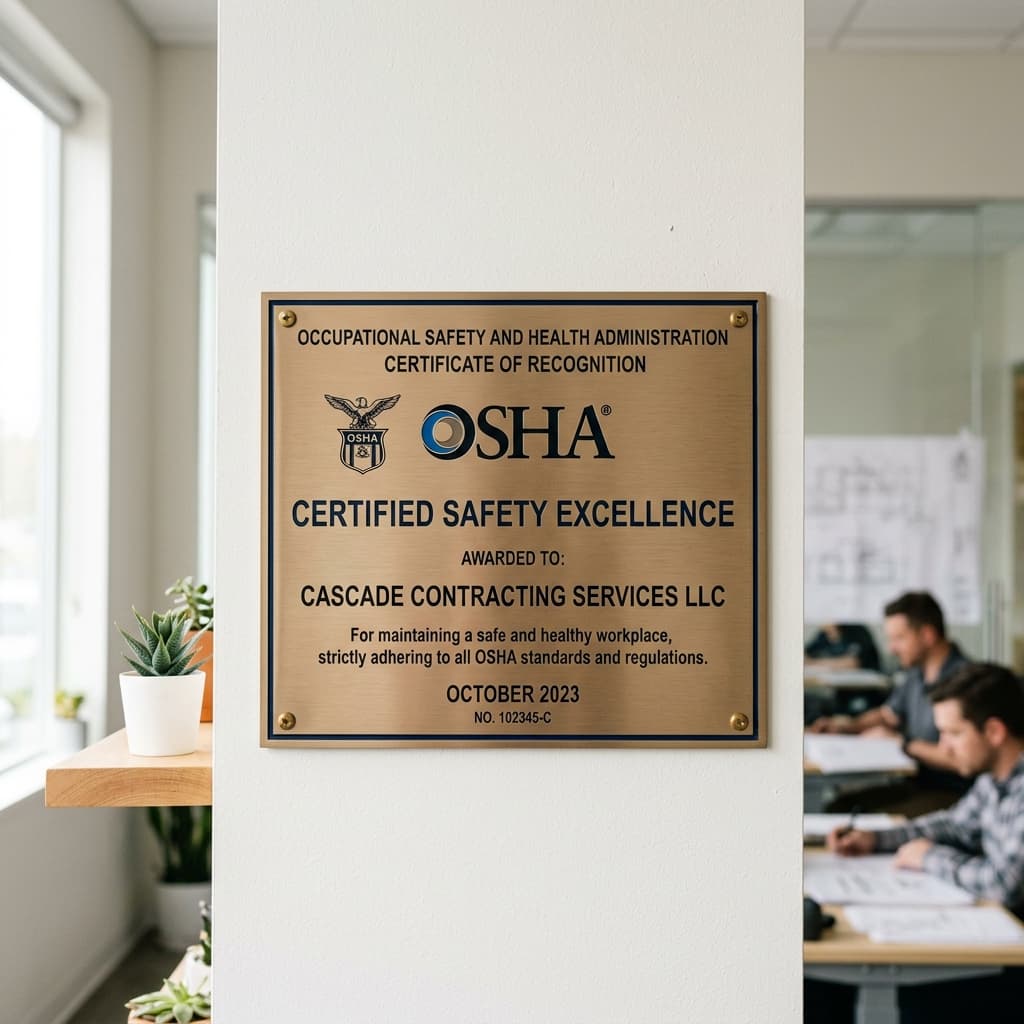
Categorizing Trust for Maximum Conversion
- Safety and Compliance: EMR (Experience Modification Rate) ratings below 1.0 displayed as a numerical badge, active OSHA VPP partnerships, ISO 9001 quality management certifications, and ANSI safety compliance verification. These prove your jobsites don't get shut down due to negligence and that your workers' compensation costs are below industry average — a direct indicator of operational discipline.
- Financial Solvency: Bonding capacity limits displayed prominently (e.g., "Single Project Bond: $25M | Aggregate: $75M"), banking relationship verification, Dun & Bradstreet PAYDEX score badges, and current insurance certificate summaries. These prove you have the liquidity to bankroll massive material acquisitions and subcontractor mobilization without cash flow interruption.
- Industry Authority: USGBC membership with specific LEED certification levels (Silver, Gold, Platinum), DBIA (Design-Build Institute of America) active membership, AGC chapter affiliations, local commercial real estate association memberships, and specialty trade certifications. These position your firm as a recognized authority within specific building sectors.
Placement Strategy: Engineering the Viewport
Burying your certifications on a secondary "About Us" page is not just a design oversight — it is a conversion catastrophe. Trust badges must be aggressively positioned in the highest-visibility zones of your website architecture. The placement strategy follows three proven high-conversion patterns that elite commercial builders deploy.
First, position a primary trust badge bar directly beneath the hero section of your homepage. This is the first content block the prospect encounters after the hero image and headline. A horizontal row of 4-6 high-resolution trust badges — each hyperlinked to the verifying organization's website for independent confirmation — creates an immediate wall of institutional credibility above the fold. The prospect hasn't scrolled past two sections and they've already visually confirmed your OSHA compliance, bonding capacity, and industry certifications.
Second, anchor a persistent trust badge strip in the global footer of every page on your website. This ensures that regardless of which page the prospect is viewing — whether it's a project case study, a team biography, or a blog post — the trust signals remain in their peripheral vision at all times. The cumulative effect of encountering these badges across multiple pages compounds the credibility signal exponentially.
Third, integrate contextual trust badges immediately adjacent to every call-to-action button on your site. Every single time a prospect considers clicking a "Request a Bid" or "Schedule a Consultation" button, a line of authoritative trust seals should be within their peripheral vision. This placement leverages the psychological principle of "decision-point reassurance" — providing credibility validation at the exact moment the prospect is most vulnerable to hesitation.

Speak Through Your Credentials
Words are cheap in construction marketing. Every contractor from the solo handyman to the $100M general contractor claims to be "the best," "dedicated to quality," and "committed to safety." These claims are meaningless without independently verifiable evidence. Elite construction firms do not argue their value; they prove it through uncompromising, verified third-party endorsements visibly stamped across their digital real estate.
The mathematics of trust badge deployment are compelling. Implementation requires zero ongoing cost after the initial design integration — you already have these certifications, you're simply failing to display them effectively. The conversion impact, however, can be substantial. Web analytics firms have consistently documented 15-30% increases in form submission rates when trust badges are positioned adjacent to conversion points. For a commercial construction firm where a single form submission can lead to a $5M-$25M contract, even a 10% improvement in conversion rate represents millions of dollars in additional pipeline value annually.
Your website is not a brochure. It is an automated due diligence machine. Every pixel should be engineered to systematically dismantle investor objections and accelerate the path from "first visit" to "signed contract." Trust badges are the most efficient mechanism available to accomplish this — require zero content creation, leverage the authority of institutions your prospects already respect, and operate 24/7 without consuming a single hour of human bandwidth.

Command Enterprise Trust with Lemonade Ideas
If your digital presence isn't actively destroying investor objections, you are leaving millions on the table. Lemonade Ideas engineers high-conversion web architectures that integrate psychological trust triggers for elite California contractors.
Engineer My AuthorityYou may also find valuable

Mobile First Contractors: The Unspoken Pass/Fail Test for $10M+ Bids
April 8, 2026
The $20M Capital Leak: Why Elite Builders Lose Bids Over "Not Secure" Hosting Warnings
April 9, 2026
BBB Accreditation ROI: Why Elite Contractors Treat BBB as a $500K Trust Signal Investment
April 10, 2026