Let's address the elephant in the boardroom: traditional B2B marketing in the construction sector is overwhelmingly passive. You buy a billboard, you wrap a truck, or you sponsor a local golf tournament, and then you sit back and pray that the right developer or property manager happens to look up at the exact right moment. This strategy is fundamentally flawed because it operates on hope rather than precision. In the multi-million dollar commercial construction arena, "hope" is a terrible strategy for lead generation. This technical breakdown explains exactly how elite general contractors are utilizing spatial marketing technology—specifically Contractor Geofencing Ads—to draw microscopic digital perimeters around their rivals' most lucrative active jobsites, effectively hijacking highly-qualified B2B attention directly to their own sales funnels.

The Architecture of Digital Conquesting
Geofencing is not a new concept; it has been used by retail giants for years to push discount coupons to shoppers walking near their stores. But applying it to high-stakes commercial construction requires a different operational mindset. We refer to this specific B2B application as "Digital Conquesting."
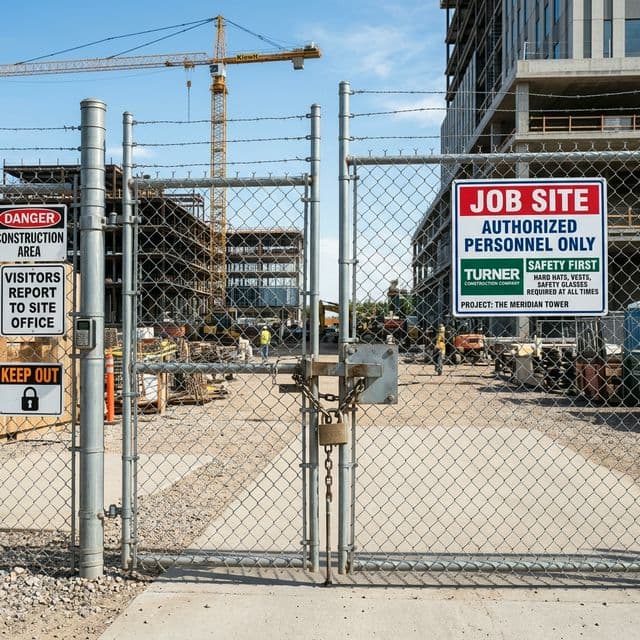
Instead of targeting a demographic (e.g., "Men aged 35-55 interested in real estate"), you target absolute geographic intent. When your primary competitor, let's call them Apex Builders, lands the $40M medical plaza contract downtown, they put up a massive, beautiful mesh banner on their chain-link fence. That banner says "Apex Builders" in 10-foot letters.
When a competing developer, a wealthy healthcare investor from out of town, or a senior property manager drives by that impressive site, what is their immediate reaction? They are intrigued. They might pull out their smartphone right there in the passenger seat, or later during their lunch break at a nearby restaurant, to research commercial builders.
The Fatal Flaw of Generic Search Ads
Most contractors combat this by buying Google Search Ads for terms like "Commercial Builders Near Me." This is a bloodbath of wasted capital. You are paying $35 per click to fight against 15 other companies, and half of those clicks are teenagers researching a school project or small-time residential flippers looking for a cheap framing crew. Contrast this with drawing a brutal, invisible digital lasso exclusively around Apex's $40M worksite.
How the Fence is Built (The Technology Stack)
Deploying a Contractor Geofencing campaign is surgically precise. Here is the exact technical progression we use to hijack the airspace above your competitor's jobsite:

- Phase 1: GPS Polygon Mapping. Using an advanced Demand-Side Platform (DSP), we pull up satellite imagery of the target area. We do not use a "radial" 1-mile circle. A circle is sloppy; it captures nearby residential neighborhoods and irrelevant fast-food restaurants. Instead, we draw a custom programmatic polygon tracing the exact property lines of the competitor's jobsite.
- Phase 2: Mobile ID Capture. When any human steps into that polygon—whether an investor visiting the site, an architect auditing the framing, or a developer inspecting the progress—and opens an ad-supported app on their smartphone (like a weather app, Forbes, or ESPN), their unique Mobile Advertising ID (MAID) is instantly captured and tagged by the satellite array.
- Phase 3: The Retargeting Tail. This is the crucial lever. The ad doesn't only show up while they are standing in the dirt. Once their device is tagged, it is digitally "sticky." We now have the absolute authority to serve high-end display and video ads to their device for the next 30 to 60 days, no matter where they go.
The Creative Layer: What Does the Ad Actually Say?
If you capture high-value C-suite traffic and serve them an ad that says "Bob's Contracting - Licensed and Insured," you deserve to lose your marketing budget. When you are operating at this level of surgical targeting, the creative must be highly provocative and directly contrast with whatever frustrating experience the prospect might be having with the competitor whose site they just visited.
Consider the psychological state of a developer who just stormed off their own jobsite. Maybe Apex Builders is six weeks behind schedule. Maybe they just handed the developer a brutal change order for structural steel.

During this 30-day "sticky" period, when that angry developer is sitting in their office checking the Wall Street Journal app, they are suddenly served a beautiful, high-definition banner ad from your firm.
The ad copy must strike like a scalpel: "Fed Up With Commercial Delays? Discover How We Delivered the Downtown Logistics Hub 3 Weeks Ahead of Schedule. Guaranteed Timelines. Zero Excuses."
The developer clicks. They land on a hyper-optimized, high-conversion landing page (no generic homepages allowed here) featuring a stunning video time-lapse of your most recent triumph, a downloadable PDF on "Reducing Change Orders by 40%," and a calendar widget to book a rapid turnaround strategy session. You just stole a disgruntled, multi-million dollar client right out from under the nose of the contractor who was currently building for them.
Expanding the Perimeter: Beyond the Jobsite
While conquesting competitor jobsites is aggressive and effective, elite firms expand their programmatic geofencing strategy to intercept capital at the source.
We routinely draw polygons around:
- High-End Industry Conferences: The International Builders' Show (IBS), large regional BOMA (Building Owners and Managers Association) conventions, or commercial real estate summits. Everyone inside the Las Vegas Convention Center for three days is an extreme, verified lead. Capture them all.
- Architectural Firms: Draw a polygon directly over the corporate headquarters of the top three commercial architectural design firms in your state. Serve ads exclusively to the designers and specifiers making the material decisions before the project even goes out to bid.
- Municipal Planning Offices: Developers, expeditors, and civil engineers physically visiting City Hall to pull commercial permits are at the very inception point of funding a project. Capture their devices instantly.

The Reality Check: Volume vs. Value
It is vital to understand the metric of success in a B2B geofencing campaign. If you are comparing this to standard Google Ads or Facebook campaigns, the numbers will look alien to you.
A standard digital ad campaign relies on massive, bloated volume—millions of impressions, thousands of cheap clicks. A true commercial geofencing campaign operates on surgical scarcity. We might only capture 450 unique devices inside an architectural firm over a three-month period. Your dashboard will show very low impression volume. The Click-Through Rate (CTR) will appear statistically tight.
The ROI Asymmetry
You do not need 10,000 clicks to make this profitable. You need exactly one right click. If an $8,000 geofencing campaign targeting a massive convention center yields exactly 12 clicks, but one of those clicks is a REIT (Real Estate Investment Trust) manager who awards you a $14 million warehouse distribution center, the math is irrevocably broken in your favor. Geofencing is not about sweeping the ocean with a massive net; it is about dropping a highly expensive spear directly onto the biggest fish in the room.
In the modern era of commercial construction, letting your competitors operate in a geographic vacuum is a critical failure of imagination. If they are publicly broadcasting their success by erecting massive structures in the skyline, you have every right and technological capability to siphon the capital orbiting that success directly into your own ecosystem.

Deploy the Ultimate B2B Weapon
Are you tired of losing massive commercial bids to competitors simply because they out-marketed you? Stop relying on hope. Allow us to engineer a programmatic geofencing campaign that violently redirects high-value developer attention directly to your estimating team.
Request a Conquesting Strategy SessionYou may also find valuable

PPC Management for Construction Companies: Why 91% of Contractors Burn $50K/Year on Google Ads That Generate Zero Commercial Contracts
April 15, 2026
Retargeting Campaigns for Custom Builders: The $3M Invisible Pipeline That Converts Abandoned Prospects Into Signed Contracts
April 15, 2026
Geographic Algorithmic Dominance: Why 8-Figure Developers Demand Map Pack Ranking
April 10, 2026