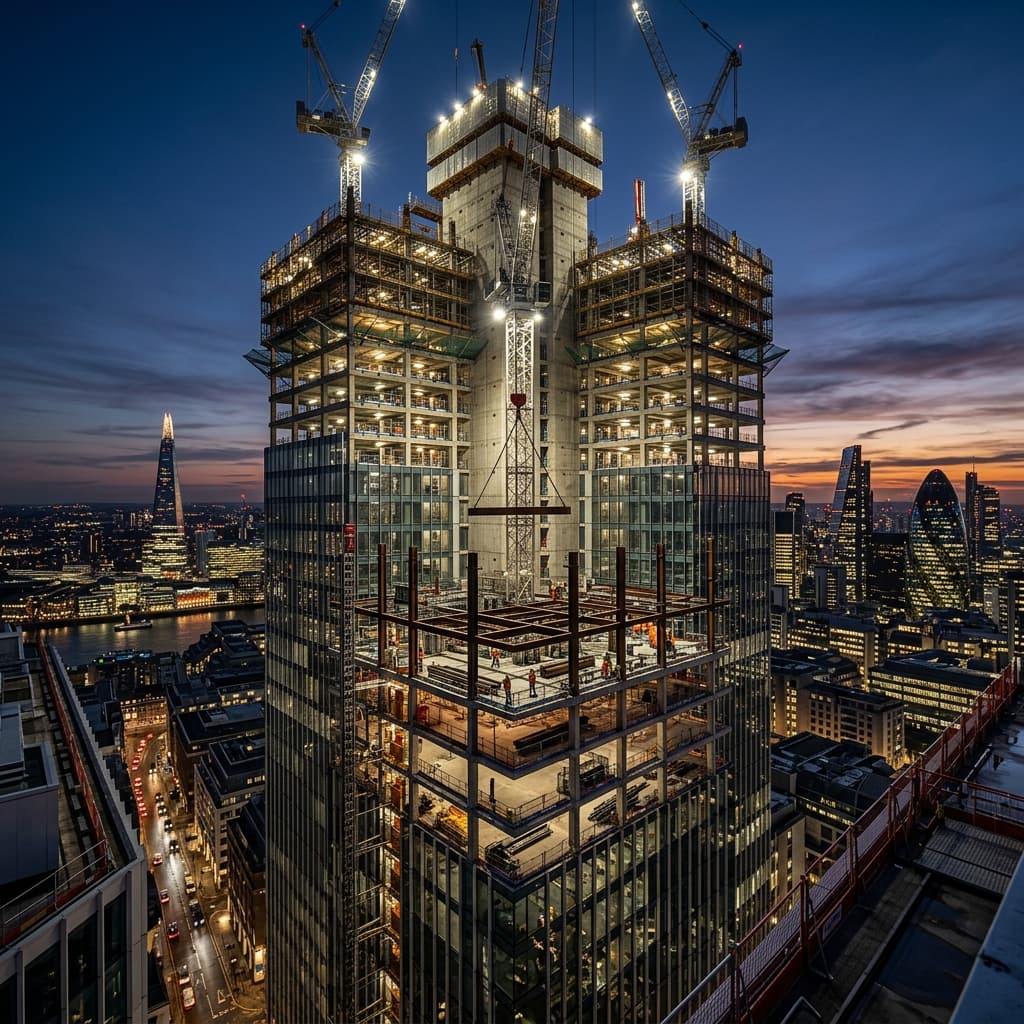
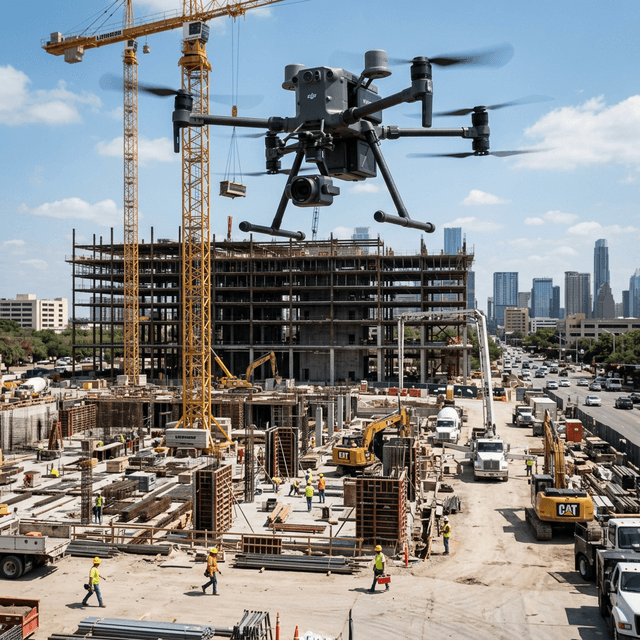
Drones in construction are no longer just expensive toys used to capture pretty sunset photos for your website banner. They are precision, mathematical data-capture instruments that routinely reduce inspection times by 60%, cut labor surveying costs by 30%, and drastically mitigate the risk of catastrophic change-order disputes. If your firm is not utilizing orthomosaic drone mapping to build technical authority, you are bleeding operational margin while your competitors use aerial data to close 8-figure commercial contracts.
The Fallacy of Traditional Site Processing
For decades, the commercial construction industry has operated on a deeply entrenched, highly inefficient model of manual surveying and disjointed progress tracking. Consider the traditional workflow for a 200-acre earthwork project: A team of highly paid, specialized surveyors systematically walks the terrain using total stations and GPS rovers. This process is inherently slow. A topographic survey of that magnitude could easily take a three-person crew upwards of two full weeks to complete, assuming perfect weather conditions and zero access restrictions.
Beyond the excruciating timeline, manual surveying introduces critical vulnerabilities regarding human error. When capturing elevation points manually, data density is inevitably sparse. Surveyors might capture a point every ten feet. What happens to the micro-variations in the terrain between those ten-foot intervals? They are estimated. They are averaged out. In the context of large-scale commercial grading, a miscalculation of a few inches across a massive parcel translates to thousands of cubic yards of misplaced earth—a mistake that results directly in devastating financial overruns.
The Financial Bleed of Manual Operations
When your project managers are spending five hours a week physically walking the perimeter of a high-rise foundation to capture 40 disjointed iPhone photos for the Friday stakeholder update, you are vastly misallocating intellectual capital. The "free" photos captured by your superintendent actually carry an astronomical hidden cost in hourly wages, lost productivity, and inferior data quality.
The paradigm has shifted. Drones (UAVs - Unmanned Aerial Vehicles) have rapidly evolved from specialized cinematic tools into essential data-capture engines. The integration of high-resolution photogrammetry software has allowed construction firms to effectively digitize the physical world with centimeter-level accuracy in a fraction of the time. We are no longer discussing "drone videos." We are discussing volumetric measurements, 3D point clouds, and undeniable visual accountability.
Phase 1: The Mathematics of Aerial Topography and Data Density
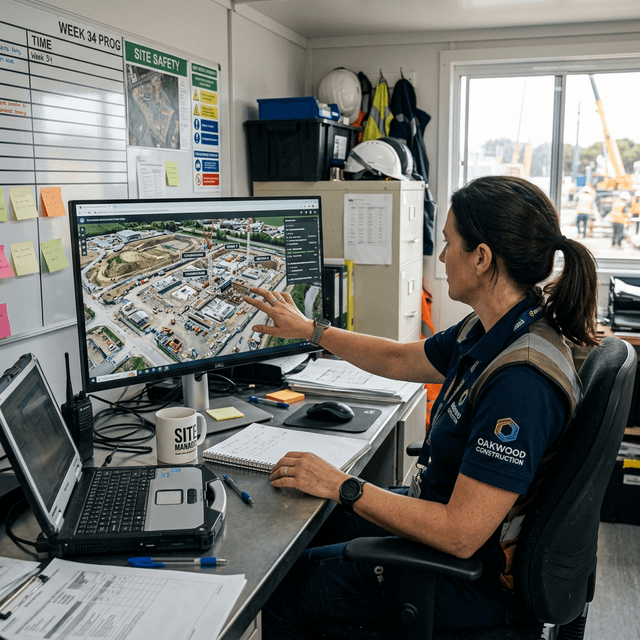
To understand the staggering 275% Return on Investment (ROI) consistently reported by early-adopting construction firms, you must understand the mathematics of data collection speed versus data density.
Let us return to the 200-acre earthwork project. Where a traditional survey crew requires two weeks to map the site collecting one point every ten feet, an enterprise-grade drone executing an automated grid flight path can map that entire 200-acre site in less than four hours.
However, the speed is only half of the equation; the density is the true differentiator. A drone capturing overlapping high-resolution images generates a 3D point cloud containing millions of individual data points. Instead of one data point every ten feet, you possess dense, continuous topographical data accurate to within 1-3 centimeters relative (and absolute, if utilizing RTK/PPK drones or established Ground Control Points).
- 80% Faster Survey Times: Compressing a highly technical two-week surveying bottleneck into a single afternoon allows excavation to commence exponentially faster. You accelerate the entire master critical path of the project schedule.
- 30% Reductions in Hard Labor Costs: By replacing weeks of extensive manual surveying labor with automated aerial photogrammetry, firms drastically reduce their direct overhead per project, immediately padding the gross margin.
- Volumetric Precision: Measuring stockpiles of aggregate, dirt, or asphalt used to require dangerous physical climbing and complex geometrical estimations. Today, drone software can isolate a stockpile on an orthomosaic map and calculate its exact volume in cubic yards within five seconds, ensuring you only pay vendors for the exact materials delivered.
The 275% ROI Calculation
A heavily documented case study regarding a large-scale highway infrastructure project revealed that implementing drone mapping generated direct savings of over $50,000 on initial surveying alone. Factoring in the hardware costs, software subscriptions, and Part 107 licensing, the financial yield resulted in an immediate 275% ROI on the technology investment before the first bulldozer even arrived on site.
Phase 2: Extreme Safety Mitigation and Hazard Detection
In the commercial construction sector, the single largest liability a firm carries is human physical safety. Insurance premiums, workers' compensation claims, and catastrophic project delays resulting from workplace injuries represent massive financial vulnerabilities that can obliterate a company's bottom line in a matter of seconds.
Routinely, construction necessitates highly dangerous inspections. Assessing the structural integrity of a massive commercial roof requires a superintendent to physically scale scaffolding, tie off to an anchor point, and manually walk a hazardous incline. Inspecting the underside of a bridge structure requires expensive snooper trucks and lane closures, endangering both the inspection crew and the driving public.
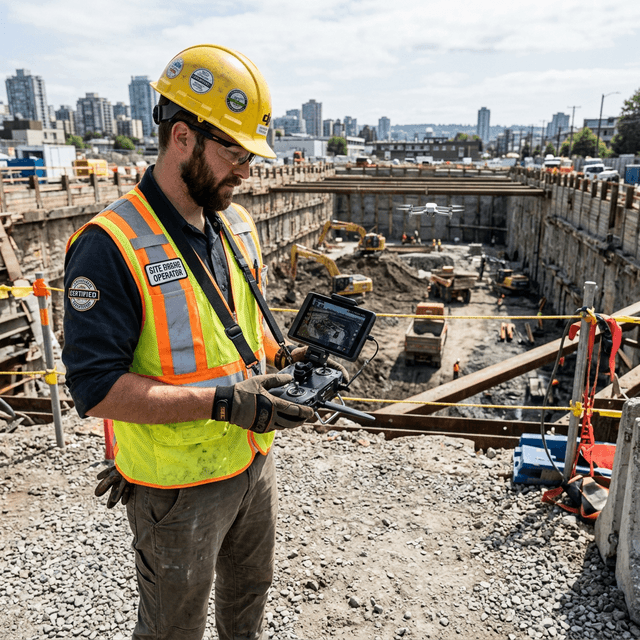
Deploying a drone for site photography completely eliminates the human physical risk vector from hazardous inspections. Operating safely from the ground perimeter, a certified FAA Part 107 pilot can fly an enterprise drone equipped with a high-resolution 4K optical zoom lens (and even thermal imaging sensors) to within three feet of a structural component.
The 40% Incident Reduction Margin
Extensive industry case studies focusing on massive commercial developments have documented up to a 40% reduction in on-site safety incidents directly attributable to drone adoption. By utilizing drones for early topographical hazard detection, roof inspections, and confined-space assessments, firms actively prevent their workforce from entering historically dangerous scenarios. The corresponding reduction in insurance premiums alone completely subsidizes the cost of the drone program.
Phase 3: The Ultimate Defense Against Costly Disputes
If you have operated in commercial construction for longer than a decade, you intimately understand the financial devastation of a protracted legal dispute regarding project timelines, change orders, or sub-contractor deliverables. When a developer claims the foundation pour was delayed by two weeks, or when a massive load of structural steel is allegedly misplaced by logistics, the resulting finger-pointing creates toxic relationships and frozen payments.
In traditional environments, defending against these claims relies on fragmented daily logs, scattered iPhone photos taken by different superintendents at different angles, and subjective memory. This is a weak, easily dismantled defense.
Drone site photography establishes the "Undeniable Timeline of Truth." When an automated flight path is programmed over the job site, the drone can execute the exact same geographic route, at the exact same altitude, capturing the exact same angles every single Friday at 3:00 PM.
The outputs from these weekly flights are processed into high-resolution, time-stamped Orthomosaic maps (a wildly detailed, zoomable, top-down map of the entire site). When integrated into a timeline slider within software like DroneDeploy or Propeller, project executives can literal slide back and forth through time to view the exact state of the job site on any specific date.
- Defeating Unjust Back-Charges: If a subcontractor attempts to back-charge the GC for delays they claim were caused by site readiness, the GC simply pulls up the time-stamped orthomosaic from that exact Tuesday, clearly showing the site was fully prepped and the subcontractor's crews were nowhere to be found. Dispute resolved in 45 seconds.
- BIM Overlay Validation: Advanced drone software allows teams to overlay the architectural CAD/BIM model directly on top of the physical orthomosaic map. Project managers can physically verify if the concrete footings were poured exactly where the blueprint specified, catching a 6-inch deviation immediately before the costly structural steel phase begins. Catching that error early saves hundreds of thousands of dollars in rework.
Phase 4: Winning High-Ticket Pipeline Through Authority Marketing
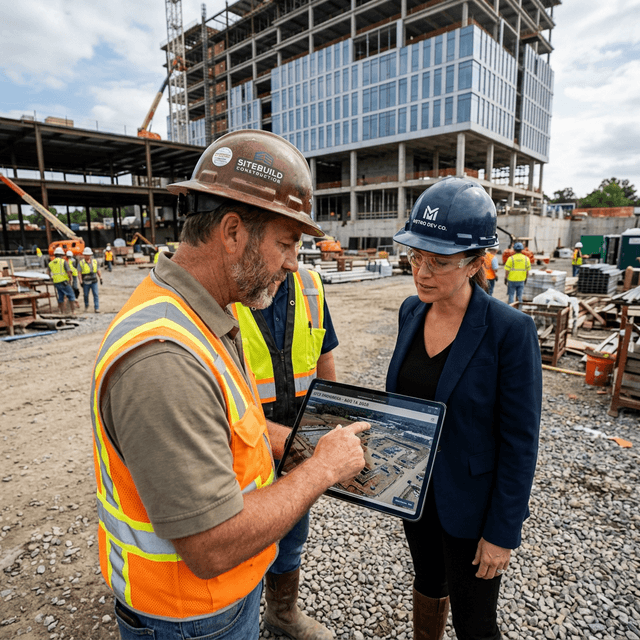
While the operational and safety ROI of a drone program is mathematically undeniable, the marketing leverage it provides is equally potent. The commercial B2B construction market is notoriously cutthroat. When a commercial developer or a municipal board is deciding who will be awarded a $45 million infrastructure contract, they are not primarily looking for the lowest bidder; they are looking for the lowest-risk partner.
If your proposal package consists of standard text-heavy documents and generic truck stock photos, while your competitor's proposal includes a highly integrated tech-stack presentation featuring weekly 3D twin generation, automated volumetric reporting, and complete visual transparency via drone mapping—your competitor is perceived as the sophisticated, lowest-risk entity.
The Visual Transparency Engine: Forward-thinking contractors utilize their drone outputs as their primary marketing collateral. They integrate the time-lapse progress videos natively onto their digital storefronts (their optimized websites). They send automated, branded, high-resolution orthomosaic progress links to their stakeholders and investors every single Monday morning.
This level of radical transparency fundamentally alters the psychological relationship with the client. It unconsciously signals: "We have absolutely nothing to hide. Our job sites are spotless, our logistics are flawless, and we have mastered the technology required to deliver your project perfectly." This perceived authority is exactly what allows premier firms to charge a premium percentage over their competitors without facing pushback during the bidding process.
Phase 5: The Cost of Inaction in a Modernizing Industry
The window for drone photography and site mapping to be considered a "novel competitive advantage" has permanently closed. It is rapidly becoming the standardized baseline expectation for any commercial firm claiming to operate at an enterprise level.
The firms that stubbornly cling to manual surveying, disjointed iPhone photo logs, and subjective timeline disputes will find their margins increasingly compressed. They will lose lucrative bids to technically sophisticated competitors who can mathematically prove they survey 80% faster, operate 40% safer, and resolve disputes instantaneously with undeniable data.
A successful drone program is not established by simply purchasing a standard DJI drone from a consumer retail store and handing it to an inexperienced superintendent. It requires a deliberate, strategic implementation involving FAA Part 107 certified pilots, specialized photogrammetry software subscriptions (like DroneDeploy or Pix4D), and a rigorous standard operating procedure regarding data storage, processing, and distribution.
However, as the data definitively proves, the friction of this implementation is vastly overshadowed by the financial yield. When a technology can isolate a structural deviation early enough to prevent a $250,000 rework entirely, or reduce labor overhead across a 2-year campus build by 30%, it transitions from a "marketing expense" into the most vital operational asset in the contractor's toolkit. The ROI is undeniable. The data is precise. The only remaining question is whether your firm will adopt the architecture of the future, or slowly bleed margin to the competitors who already have.
Phase 6: The Mechanics of an Internal Drone Program (In-House vs. Outsourced)
Once a construction firm visualizes the ROI of aerial mapping, the immediate strategic question becomes implementation. Should you build an internal drone department, or should you outsource the flights to a specialized third-party drone service provider (DSP)? Let us examine the mathematics and logistics of both approaches.
Building In-House: The Capital Investment
Establishing an internal drone program requires significant upfront capital and logistical structuring. A commercially viable RTK (Real-Time Kinematic) drone, capable of centimeter-level accuracy without the heavy reliance on Ground Control Points (GCPs), typically costs between $5,000 and $15,000. Beyond the hardware hardware, the firm must pay for the photogrammetry processing software subscription (e.g., DroneDeploy, Pix4D, or Propeller), which can range from $3,000 to $6,000 annually per user.
More pressingly, an in-house program requires severe regulatory adherence. The FAA mandates that any drone flown for commercial purposes (which includes any data collection used by a business) must be operated by a licensed Part 107 Remote Pilot in Command. This means you must select personnel (often field engineers or superintendents), pay for their training, compensate them while they study, and manage the liability of their flight operations. The hidden cost here is opportunity cost. Every hour your project manager spends legally mapping a site is an hour they are not actively managing the trades or controlling the schedule.
However, the long-term advantage of an internal program is extreme agility. When a critical issue arises on a site, your internal pilot can have a drone in the air within twenty minutes, capturing real-time data to resolve the problem immediately. For firms managing multiple massive sites in a close geographic region, the volume of flights eventually eclipses the cost of the hardware and software, leading to massive long-term ROI.
Outsourcing to a DSP: The Turnkey Solution
For mid-sized firms, or high-level contractors dipping their toes into the technology, outsourcing to a specialized Drone Service Provider is often the most mathematically sound decision. When you outsource, your firm incurs zero hardware costs, zero software subscription fees, and—most importantly—zero liability for flight operations.
The DSP handles the FAA airspace authorizations (LAANC clearance), they provide the licensed pilot, they carry the specialized aviation insurance, and they process the massive datasets on their own high-powered servers. The construction firm simply receives the final deliverable: a highly accurate 3D model, stockpile volume reports, and the clean orthomosaic map. This allows the contractor to benefit from the 275% ROI without the immense friction of building an aviation department from scratch.
Phase 7: Advanced Data Integrations (BIM Overlay and VDC)
The true power of drone site photography is unlocked when the aerial data merges with Virtual Design and Construction (VDC). The orthomosaic map is just the beginning.
When a drone finishes its flight path, the resulting 3D point cloud can be imported directly into industry-standard design software like Autodesk Navisworks or Revit. This process—known as BIM Overlay—allows project engineers to superimpose the theoretical 3D design model directly on top of the physical 3D point cloud of the actual, current job site.
The implications of this are staggering. A VDC coordinator can visually inspect if the newly installed HVAC ductwork (physical reality) clashes with the planned plumbing routing (theoretical design) weeks before the plumbers are even scheduled to arrive on site. This hyper-advanced clash detection prevents trades from halting work, redesigning systems in the field, and issuing massive change orders.
Furthermore, advanced drone platforms now incorporate artificial intelligence to track progress against the schedule automatically. The AI can look at the drone map, recognize that the concrete slab has been poured, and automatically update the corresponding task percentage in the project management software (like Procore or PlanGrid). This eliminates the subjective, manual data entry that has plagued construction schedules for decades.
Ultimately, the integration of drone data, AI processing, and BIM overlay transforms the construction site from a chaotic, physical environment into a perfectly measured, digital twin. It is the ultimate expression of control over variables, timelines, and budgets.

Build Authority. Prove ROI. Close the Contract.
If you are tired of competing on price and want to utilize advanced technical assets to build a predictable, self-owned inbound lead generation engine for your construction business, let's architect the strategy.
Request a Strategy SessionTambién te puede interesar

Recorridos Virtuales 3D en Pre-Construcción: La Máxima Defensa Contra la Corrupción del Alcance
16 de Marzo, 2026
Testimonios en Video de Contratistas: El ROI Matemático en la Prueba de Clientes
16 de Marzo, 2026
Mapas de Proyectos Interactivos: Cómo Constructores de Élite Validan Capacidades de $50M Sin Decir una Palabra
8 de Abril, 2026